One late spring day an older Asian woman came in and started asking questions of a young high schooler who had been hired mostly just to water plants. The poor girl looked thoroughly confused, and the older woman seemed to be getting agitated, so I casually walked by to see if I could help.
 It took me a while to figure out what she wanted... but eventually I caught the words "bitter melon" and understood that she was looking for a vegetable she had purchased there the year before. I took her in to look at our supplier lists, as we frequently would add specialty plants to our orders at a customer's request... but unfortunately they were not available from the grower.
In spite of a few language barriers, she and I had a wonderful conversation about the bitter melon. It seemed to be an heirloom type vegetable and she assured me that it was commonly used in Asian cuisines. My curiosity was aroused enough that I decided to look into it sometime... but I admit that by the time I left, the words "bitter melon" had left my head entirely.
This spring, my friend Pete called me to ask about spring bulbs and the best time to plant annuals. Pete's family owns a wonderful restaurant that serves both Chinese and Vietnamese dishes (and a whole steamed fish that's to die for) and we ended up talking about food and growing our own vegetables.
Suddenly, my conversation with the older woman popped back into my head. "Hey Pete, last year there was this woman who came into the garden center looking for a certain Asian vegetable... I can't remember what it was called, but she said it was really bitter..."
Turns out that Pete's Mom grows it every year, but they call it bitter gourd. He promised me seeds but did one better by bringing over tiny seedlings in the early summer. Unfortunately the seeds had been started a little late because of our cool spring--and I didn't get them into the ground early enough, either. I ended up with just one bitter melon on my vines, but I did get to enjoy the gorgeous leaves and fairly neat growing habit of the plant itself.
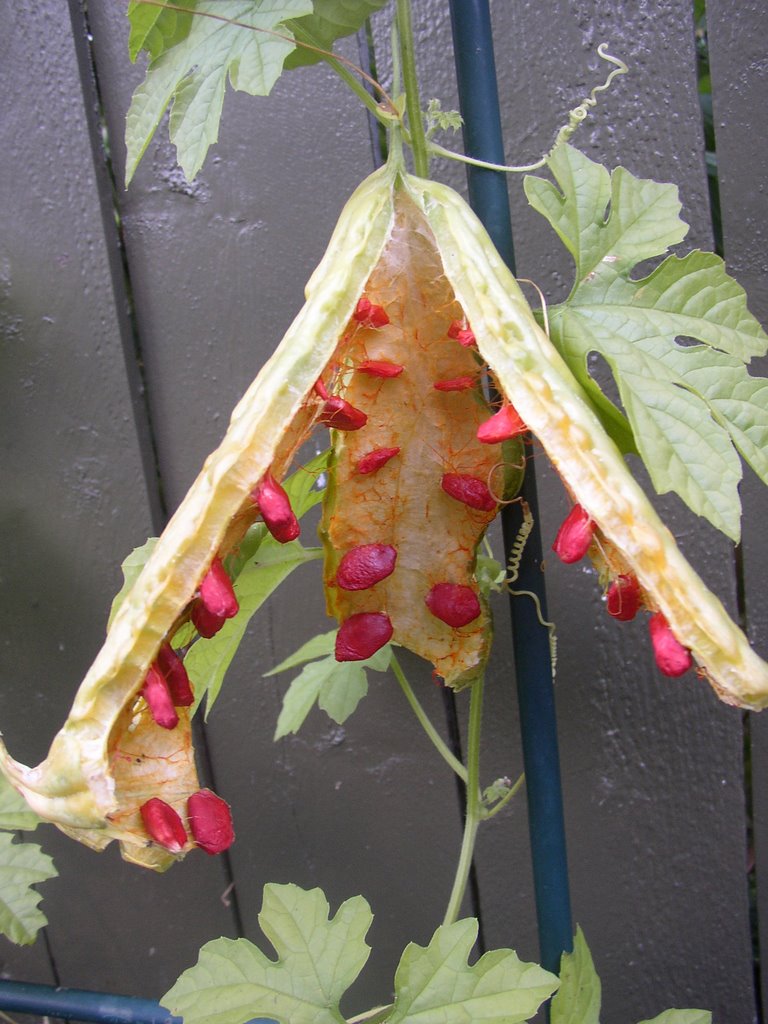 Pete offered me seeds again next year, but I decided to just let this one go to seed and try it myself. The seeds are a gorgeous red, and almost dry. When the fruit first split open they looked like huge, sticky pomegranate seeds. Pete says to leave them for a bit yet, but that they're almost ready to harvest.
When Pete figured out that I wasn't going to get any fruit from mine this year, he brought me over a quart of his Mom's homemade soup with bitter melon and pork. It's hard to describe how the bitter melon tasted... kind of bitter in the way that uncooked overgrown zucchini can be. The soup would have been kind of meaty and maybe even too greasy for my taste without the bitter melon to cut through it, but as it was it was really delicious. I can't wait to try this stuff in recipes--I'm thinking that it would be good with asiago cheese for some reason. (Yeah, okay, probably because I'm addicted to asiago cheese in general.)
If you go online and google bitter melon, you'll find a bunch of references to its supposedly "miraculous" medicinal properties. One site says that eating raw bitter melon every day can cure you of diabetes. Another touts it in pill form. Maybe they operate on the assumption that something so bitter and difficult to eat MUST be good for you?!
According to the National Bitter Melon Council, it has twice the potassium of a banana, twice the calcium of spinach, twice the beta-carotene of broccoli, is rich in iron, and offers a host of other vitamins as well. I'm not looking to live to be 150 or use it to cure an illness, though. I'll admit it: I just like to grow quirky produce every now and again. :)

No comments:
Post a Comment