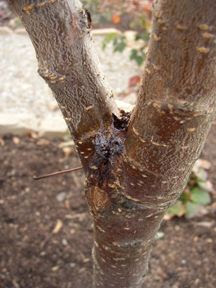
While out taking pictures in my garden in December, I noticed some very disturbing areas of gumming on my young Bing cherry tree. I took a few pictures of the affected areas, and began to research.
You know how it goes when you're researching diseases. First you have yourself convinced that you are looking at the worst case scenario. Then you go through a phase where you search for symptoms that would prove your ailment is something extremely treatable that can be mistaken for the more dire consequence.
Time and even more research seems to bring answers. The more I read about bacterial canker on cherry trees, the more I became convinced that this is what is afflicting my Bing--not an "easier" problem like winter injury.
The final nail was driven when I read about "dead bud disease," which is a manifestation of bacterial canker that causes buds to die back on the spurs in the spring. I saw that happen on this cherry (but only this cherry) in the spring of 2006, but had attributed the dieback to a very late freeze. I am pretty confident that this tree must have been infected already when I brought it home from the nursery in late 2005.
Some sites say that you can cauterize the cankers to help kill bacteria that live on their margins, or even dig them out with a knife. I simply am not willing to do all kinds of spraying and babying when I have such limited space in the garden--even though both my Dad and I love sweet cherries, halved and frozen--so on the first reasonably warm day I will go outside and remove it.
I do have two other cherry trees, one sour and one sweet. Neither variety is supposed to be as susceptible to bacterial canker as the Bing, and neither is showing any sign of disease. They both have resided a good distance from the Bing within my garden, so it is possible that both are still healthy.
However, if I pull out the Bing I will probably pull out the other sweet cherry regardless of its health. I only purchased it in the first place to pollinate the Bing, and I really have no other place to locate a pollinator for it except for the space where the Bing currently resides. I am very leery of planting another sweet cherry there.
Ideally, I will replace the healthy sweet cherry with another sour cherry, this one a larger variety than the dwarf 'Northstar' that I have. As for the spot where the diseased cherry was discovered, I'm still not sure. I think I need to go research elderberries, which I previously discounted for lack of space. Anyone know if the berries from those pretty dark-leaved sambucus nigra cultivars like Black Beauty make good jelly--or wine?


No comments:
Post a Comment