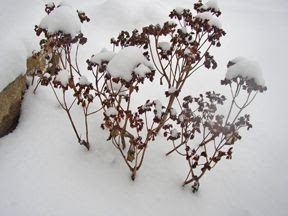
I have been reading with interest several web forum and blog posts about the issue of cleaning up your garden in the winter. Many gardeners--more than I would have anticipated--have confessed that they can't stand seeing dead plants in their garden at all. Some cut the plants down as they die, others do their garden cleanup in one fell swoop in the fall or early winter.
On the one hand, I can understand this compulsive cleanliness. On the other, I really feel that neat-as-a-pin gardeners may be missing out on a whole lot of winter interest. "A plant is only worth growing if it looks good when it is dead," says Piet Oudolf as quoted in Noel Kingsbury's recent book, Seedheads in the Garden. He was apparently half joking, but why not at least leave up those plants in your garden that don't turn to mush at the first sign of cold? Especially if you live in a climate where a quarter or so of every year is taken up by the monotonous grey/brown/white of winter.
Dead plants -- especially umbellifers, like bronze fennel, and those with sturdy skeletons like tall sedums, echinacea purpurea, and eryngium yuccafolium -- can collect interesting dabs of snow on their dried seedheads and other horizontal surfaces. Thin, brittle stems and bunched dried flowers on a background of soft white snow can give the effect of a lovely ink drawing right in your garden.
The worst plants to cut back too early, IMHO, are the grasses. Unlike the stick-straight architectural plants, the grasses contribute much-needed movement to the winter garden. They always remind me of the life hidden beneath the snow as the tips of their blades move to and fro in the winter winds.
 (As Henry Mitchell noted, "I do say it takes very little to convince a a gardener he will make it right into spring." For me, all it takes is a few swaying grasses.)
Even those plants that are not much to look at during the winter... well, at least give you something to look at during the winter! I forget that I still have hollyhock foliage until the snow melts and the smallest of its rounded leaves pop jauntily back up into the air. I mentally tell the artemisia that it really needs a haircut when I walk past it, but I wouldn't want to cut it back in the fall and miss the way the melting snow falls through its fanned branches in small clumps.
 Check out this picture of my back garden bed. Had I cut back everything I was supposed to at the "prescribed" time, here's what would be left in terms of plant life: The rhododendron in the back, the beginnings of an espaliered firethorn against the wall, and the clump of kniphofia foliage in the front.
Since nothing was cut back, the view includes little bluestem, 'Rotstrahlbusch' switchgrass, miscanthus zebrinus, and a rose bush whose upper leaves must be frozen onto the plant at this point. When there's not 4 inches of snow on the ground, you can also see groundcover sedums, the aforementioned hollyhocks, some young lady's mantle, dried Siberian iris foliage, some dead licorice plant clumps and the silvery stems of Russian sage (they disappear against the snow but show up aginst the mulch.)
As it is, I'm upset that I did cut back most of my bronze fennel, foxgloves, 'Hillside Black Beauty' bugbane, asclepias tuberosa, and verbena bonariensis. After checking out the gorgeous arrangements that Craig at Ellis Hollow put together this fall with the dead parts of such plants, I now have plans of my own. I can't wait to harvest dried material next October for a lush--but yes, very brown--Thanksgiving centerpiece.
Now that I think about it, maybe I need to plant some more Northern sea oats... and this may just give me the excuse that I was looking for to try out phlomis russeliana, too...

No comments:
Post a Comment